The Reality of Estate Cleanouts in Wisconsin
Estate cleanouts are among the most emotionally and logistically demanding tasks Wisconsin families face. Whether you're clearing a parent's home after a loss, managing an inherited property in Plymouth, or helping a family member downsize from a decades-long residence in Sheboygan County, the combination of grief, time pressure, and sheer volume of accumulated belongings can feel overwhelming.
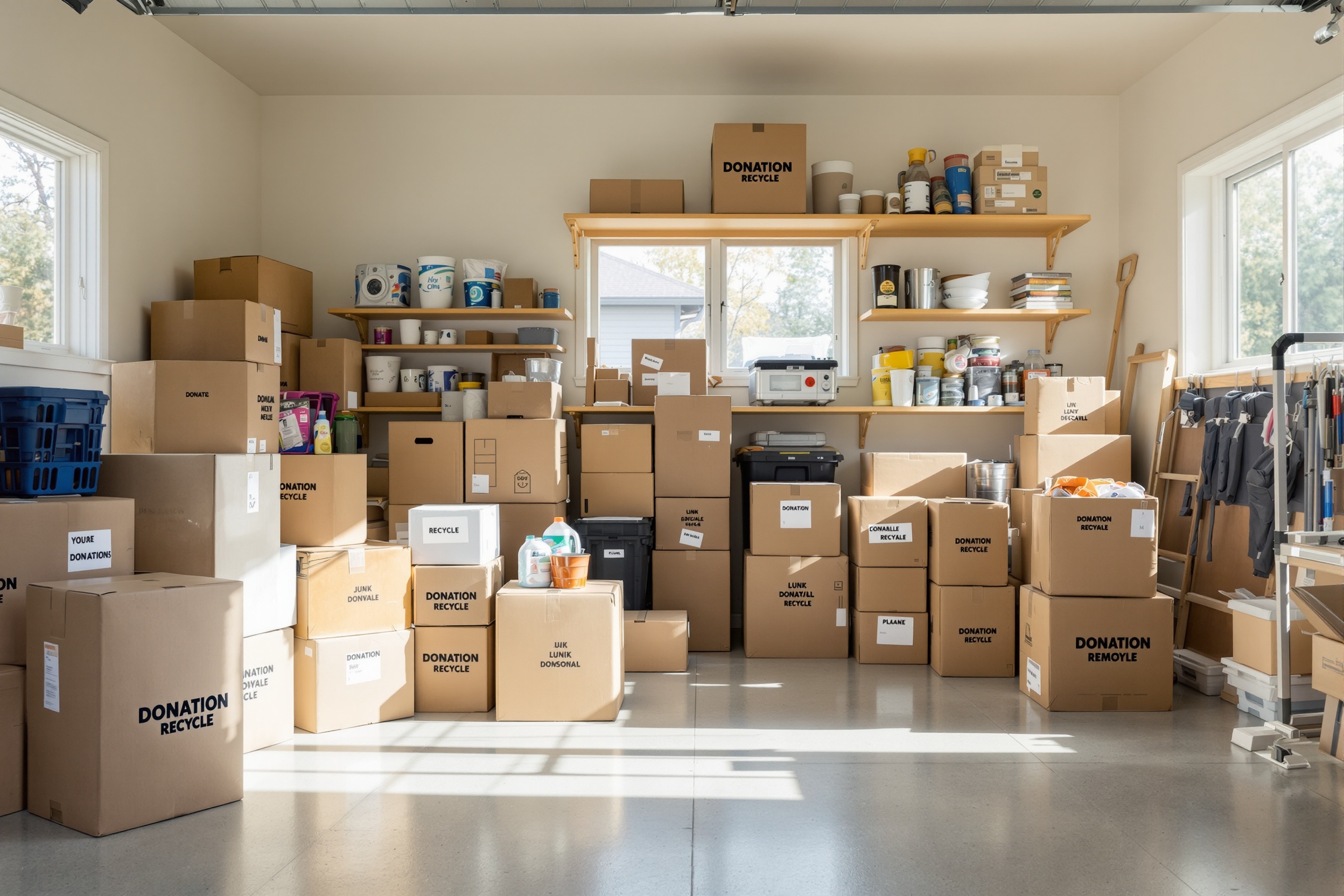
The practical reality is that most Wisconsin estate cleanouts involve homes where belongings have accumulated over 30, 40, or 50 years. Basements hold forgotten furniture and appliances. Attics contain boxes that haven't been opened since the 1980s. Garages are packed with tools, equipment, and seasonal items. Closets hold clothing from multiple decades. The scope is almost always larger than families anticipate.
This 10-step checklist is designed to make the process manageable — breaking an overwhelming task into concrete, sequential actions that any family can follow. It covers everything from initial assessment and document security to donation coordination, hazardous material disposal, and final property preparation, with specific resources for Plymouth and Sheboygan County throughout.
Step 1: Assess the Full Scope Before Touching Anything
The most important step in any estate cleanout is the one most families skip: a complete, documented assessment of the entire property before moving or disposing of a single item. Walk through every room, closet, storage area, basement, attic, garage, shed, and outdoor space. Take photos and videos of everything. Note the volume of items, identify potential valuables, and flag any hazardous materials that will require special handling.
This assessment serves multiple purposes. It gives you an accurate picture of the project scope for timeline and resource planning. It creates a photographic record that can be valuable for estate settlement, insurance purposes, or family disputes about specific items. And it prevents the common mistake of accidentally disposing of valuable items during the initial "obvious junk" removal phase.
Pay particular attention to unusual storage locations. Elderly Wisconsin residents often store valuables, cash, and important documents in unexpected places — inside books, behind wall panels, in the back of closets, under floorboards, inside appliances, or in outdoor structures. A thorough initial walkthrough before any disposal begins is the best protection against accidentally discarding something irreplaceable.
Pro Tips
- Use a room-by-room checklist to ensure no space is overlooked
- Video walkthrough is more comprehensive than photos alone
- Note any items that appear valuable for professional appraisal
- Flag hazardous materials (paint, chemicals, old appliances) for special handling
- Estimate volume in each space to plan for dumpsters or junk removal trucks
Step 2: Secure Important Documents and Valuables Immediately
Before any sorting or disposal begins, conduct a targeted search for important documents and valuables. This search should happen on your first visit to the property, before anyone else has access. Important documents include: the will and any codicils, property deeds and titles, insurance policies (life, health, home, auto), financial account statements, investment and retirement account documents, tax returns (keep at least 7 years), Social Security cards, birth certificates, passports, and military records.
Financial documents are particularly important to secure quickly. Bank account numbers, investment account information, and Social Security numbers in unsecured documents create identity theft risk. Gather all financial documents into a secure container and remove them from the property on your first visit.
For potential valuables — jewelry, coins, collectibles, antiques, artwork — resist the urge to make quick disposal decisions. Items that appear ordinary may have significant value to collectors or appraisers. A piece of Depression-era glassware, a vintage tool collection, or a set of old coins might be worth hundreds or thousands of dollars to the right buyer. Schedule a professional estate appraiser before disposing of anything that might be valuable — the cost of an appraisal is almost always recovered through better sale prices.
- Legal documents: Will, trusts, power of attorney, healthcare directives
- Property documents: Deeds, titles, mortgage documents, property tax records
- Financial documents: Bank statements, investment accounts, retirement accounts
- Insurance policies: Life, health, home, auto, long-term care
- Identity documents: Social Security cards, birth certificates, passports, military records
- Tax records: Returns and supporting documents for at least 7 years
- Valuables: Jewelry, coins, collectibles, artwork, antiques
Step 3: Establish a Realistic Timeline and Coordinate Family
Estate cleanouts in Plymouth and Sheboygan County typically take longer than families expect. A standard 3-bedroom home with a full basement and garage realistically requires 5-10 days of active work for a family team, or 2-3 days with professional estate cleanout assistance. Larger properties, homes with extensive collections, or situations involving family disagreements about items can extend this significantly.
Family coordination is often the most challenging aspect of estate cleanouts. Different family members have different emotional attachments to different items, different ideas about what should be kept versus sold versus donated, and different availability for the physical work. Establish clear decision-making protocols before work begins: Who has final say on disputed items? What is the deadline for family members to claim items they want? How will proceeds from sold items be distributed?
Build emotional processing time into your timeline. Estate cleanouts are grief work as much as physical work. Expect that sorting through a loved one's belongings will surface emotions, memories, and family dynamics that require time and space to process. Rushing the emotional aspects to meet an arbitrary deadline creates regret and family conflict. Schedule breaks, plan for difficult days, and give yourself permission to slow down when needed.
Step 4: Sort Systematically Using the Five-Category Method
Systematic sorting is the operational core of any successful estate cleanout. The five-category method — Keep, Sell, Donate, Recycle, Dispose — provides a clear framework for every item decision. Set up physical staging areas for each category, using colored tape, labels, or designated rooms to keep categories organized as sorting progresses.
Work room by room rather than jumping between spaces. Starting with less emotionally charged areas (bathrooms, linen closets, utility rooms) builds momentum and decision-making confidence before tackling more difficult spaces (bedrooms, living rooms, personal collections). Save the most emotionally significant spaces — the primary bedroom, personal study, or hobby room — for when you've developed a rhythm and emotional resilience.
For items with sentimental value that you can't keep physically, consider digital preservation. Photograph meaningful items before letting them go. Scan old photos and documents. Record video of yourself describing the history and significance of items. These digital records preserve memories without requiring physical storage, making it easier to let go of items that would otherwise create clutter in your own home.
- Keep: Family heirlooms, photos, important documents, items with genuine personal significance
- Sell: Antiques, collectibles, quality furniture, jewelry, valuable tools and equipment
- Donate: Usable furniture, clothing, household goods, working appliances, books
- Recycle: Electronics, appliances, metals, paper, cardboard, glass
- Dispose: Broken items, hazardous materials, unsalvageable goods, items with no reuse value
Pro Tips
- Set a 60-second decision rule: if you can't decide in 60 seconds, it goes to "sell" for later evaluation
- Take photos of sentimental items before letting them go
- Start with bathrooms and utility rooms to build momentum
- Schedule regular breaks — estate cleanout is emotionally exhausting work
Related Services
Step 5: Handle Hazardous Materials with Wisconsin Compliance
Older Wisconsin homes — particularly those built before 1980 — frequently contain hazardous materials that require specialized disposal. This is not optional: Wisconsin DNR regulations and federal EPA rules prohibit disposing of many common household chemicals, electronics, and certain building materials in regular trash or landfills.
Paint is the most common hazardous material found in estate cleanouts. Decades of accumulated latex and oil-based paint, stains, varnishes, and solvents are standard in Wisconsin basements and garages. Sheboygan County's Household Hazardous Waste program accepts these materials at no charge to county residents. Never pour paint down drains or into the ground — even latex paint contains biocides and pigments that contaminate soil and groundwater.
Homes built before 1978 may contain lead-based paint, and homes built before 1980 may contain asbestos in insulation, floor tiles, ceiling tiles, and pipe wrap. If you suspect either material, do not disturb it — contact a certified inspector before proceeding with any renovation or demolition work. Disturbing lead paint or asbestos without proper precautions creates serious health hazards and significant legal liability.
- Paint and finishes: latex paint, oil-based paint, stains, varnishes, paint thinners
- Automotive fluids: motor oil, antifreeze, brake fluid, transmission fluid, gasoline
- Pesticides and herbicides: weed killers, insecticides, fungicides, rodenticides
- Cleaning chemicals: drain cleaners, oven cleaners, pool chemicals, concentrated bleach
- Batteries: car batteries, rechargeable batteries, lithium batteries
- Fluorescent bulbs and CFLs (contain mercury)
- Propane tanks — even "empty" tanks retain residual gas
- Suspected asbestos or lead paint — requires certified professional assessment
Step 6: Coordinate Donations with Local Plymouth Charities
Donation is one of the most meaningful ways to honor a loved one's memory — their belongings continue to serve others in the Plymouth and Sheboygan County community rather than going to a landfill. But successful donation requires coordination, not just good intentions. Call ahead to confirm acceptance policies, schedule pickup appointments for large items, and understand what each organization can and cannot accept.
Goodwill's Sheboygan location accepts clothing, household goods, small furniture, and working electronics. Habitat for Humanity ReStore in Fond du Lac is the best destination for furniture, working appliances, and building materials — items that directly fund affordable housing construction. St. Vincent de Paul Society in Plymouth accepts clothing, household items, and small furniture, with proceeds supporting local families in need.
Get itemized donation receipts for every donation. These receipts are valuable for estate tax purposes — donated items can be deducted at fair market value, potentially reducing the estate's tax burden. Keep receipts organized with descriptions and estimated values. For large donations (furniture, appliances, significant quantities of goods), consider having a tax professional review the documentation to maximize legitimate deductions.
Step 7: Consider an Estate Sale for Valuable Items
If the estate contains significant quantities of antiques, collectibles, quality furniture, tools, or household goods, an estate sale can generate meaningful proceeds while efficiently liquidating large volumes of items. Professional estate sale companies in Wisconsin handle pricing, advertising, staging, and sales — typically taking 25-35% of gross proceeds as their fee.
Estate sales work best when there's sufficient volume and quality to attract buyers. A home with 40+ years of accumulated belongings, quality furniture, vintage items, or specialized collections (tools, books, art, coins) is an excellent estate sale candidate. Homes with primarily modern, mass-market goods may not generate enough interest to justify the effort.
Online alternatives — Facebook Marketplace, Craigslist, eBay, and specialized platforms like Chairish for furniture and Reverb for musical instruments — allow you to sell items individually at your own pace. This approach takes more time but often yields higher prices for specific items. Consider a hybrid approach: professional estate sale for the bulk of items, online sales for the highest-value pieces.
Step 8: Arrange Professional Junk Removal for Remaining Items
After donations, sales, and family distributions are complete, the remaining items need professional junk removal. Plymouth-area junk removal services handle furniture, appliances, electronics, mattresses, yard waste, and general household items efficiently, with many offering same-day or next-day service for estate cleanouts.
Choose a junk removal service that prioritizes recycling and donation. The best companies in Sheboygan County sort collected items and route them to appropriate recycling facilities, charity partners, and disposal sites — minimizing landfill waste even for items you've already decided to dispose of. Ask specifically about their recycling rate and charity partnerships before booking.
For large estate cleanouts, consider renting a dumpster for a week rather than scheduling multiple junk removal pickups. Dumpster rental allows you to work at your own pace, filling the container as you sort, without coordinating multiple pickup appointments. This is particularly useful when the cleanout timeline is uncertain or when family members are working in shifts over multiple days.
Step 9: Deep Clean and Prepare the Property
Once all items have been removed, the property needs thorough cleaning before it can be sold, rented, or transferred. This goes beyond standard cleaning — estate properties often have areas that haven't been cleaned in years, and the removal of furniture and appliances reveals accumulated dust, grime, and sometimes damage that needs addressing.
Professional cleaning services are worth the investment for estate properties. They have the equipment and expertise to handle deep cleaning of carpets, hard floors, windows, bathrooms, kitchens, and appliances efficiently. For properties with significant odors (smoke, pets, moisture), professional odor remediation may be necessary before the property is marketable.
Address minor repairs and maintenance issues identified during the cleanout: leaky faucets, broken fixtures, damaged walls, non-functioning light switches, and similar items. These small repairs have outsized impact on property value and buyer perception. A clean, well-maintained property sells faster and at higher prices than one with obvious deferred maintenance.
Step 10: Prioritize Your Own Emotional Well-Being
Estate cleanouts are grief work. The physical labor of sorting, lifting, and disposing of a loved one's belongings is inseparable from the emotional labor of processing loss, confronting mortality, and navigating family dynamics under stress. Acknowledging this reality — rather than trying to power through it — leads to better outcomes for everyone involved.
Take breaks when emotions run high. Give yourself permission to slow down, to sit with a meaningful item, to share memories with family members who are helping. The cleanout will get done. There is no virtue in rushing through it at the cost of your emotional health or family relationships.
Professional estate cleanout services exist precisely for situations where the emotional burden is too heavy to manage alongside the physical work. These services handle the entire process — sorting, valuation, donation, recycling, and disposal — with professionalism and sensitivity. Using professional help is not a failure; it's a practical choice that allows you to focus on healing while ensuring the practical aspects are handled competently and respectfully.
Pro Tips
- Schedule regular breaks and meals — physical and emotional work requires fuel
- Designate one family member as the decision-maker to prevent circular debates
- Consider professional estate cleanout services for large or emotionally complex situations
- Remember: letting go of physical items does not mean letting go of memories or love
Wisconsin-Specific Considerations for Estate Cleanouts
Wisconsin estate cleanouts have unique practical considerations beyond the standard checklist. Winter weather can significantly complicate outdoor work and junk removal logistics — plan major outdoor phases for spring through fall when possible. Many older Wisconsin homes have basements prone to moisture and seasonal flooding; address any water intrusion issues during the cleanout to prevent mold growth in a vacant property.
Wisconsin estate law has specific requirements for property disposition, creditor notification, and estate settlement timelines. If the estate is going through probate, certain property disposals may require court approval. Consult with a Wisconsin estate attorney before selling or disposing of significant assets to ensure compliance with state law and protection from personal liability.
Finally, be aware that Wisconsin's cold winters can cause rapid deterioration in vacant properties — frozen pipes, ice dams, and heating system failures are common in unoccupied homes. Ensure the property is properly winterized if it will be vacant through the winter months, and arrange for regular check-ins to catch problems before they become expensive emergencies.
About the Author
Mike Johnson has over 12 years of experience helping Wisconsin families navigate estate cleanouts with compassion, efficiency, and professionalism. He specializes in providing practical guidance for the logistical and emotional challenges of estate clearing in Plymouth and Sheboygan County, with deep knowledge of local donation resources, recycling facilities, and Wisconsin estate regulations.